As an extremely novice birder, I am enjoying expanding my vocabulary to describe and identify the feathered people living in my new country setting. I could not do this without the help of friends who have flown farther down this particular bird trail. Alison, for one, has become my fall-back gal for identification, but I also rely on the Mt. Diablo Audubon's list-serve, East Bay Birders, for the constant stream of bird notices that are sent out in emails every day, notifying Bay Area folks of who and what and how many are flying through.
My first encounter with birders, however, was not so pleasant. It seemed odd that we would go out all in a bunch, with scopes and guidebooks, while some seemed exceedingly competitive about getting the name out first of a particular bird sited. And, I struggle with whether knowing a bird's name--a man-given nomenclature, after all--really helps me know the bird any better.
Nonetheless, when I spotted this yellow brilliance on a utility pole just outside the house about two weeks ago, I was eager to know what name he goes by (he must surely be a "he," because in the bird realm, the brightest and showiest are usually male). I guessed some kind of oriole by using two or three of the usual birder books (Petersen's, Sibley's), but it was my friend, Alison, who affirmed my suspicion that he is a Hooded Oriole.
Old Hoodie came back after a week. I heard his slight single-noted song, not very fancy but unique and went outside to snap the photo. I feel lucky he has visited twice. This is my first encounter with him and I hope he will return, whether or not I call him by his right name.
We are also getting our red-wing blackbirds in abundance. I took a number of shots down at the Port Costa Reservoir.
Tuesday, April 27, 2010
Wednesday, April 7, 2010
Species Coexistence
Our birdfeeder has finally been discovered by a squirrel, and the neighbor's cat Ziggy. I'm surprised it took a month to attract anyone other than the birds, mostly house finch and scrub jay, a few white-crowned sparrows, who visit the front yard feeder.
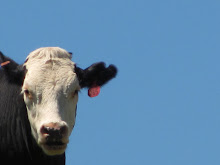
On the hillside just opposite our front, we have watched cows and wild turkeys taking turns in the green green grass. They never seem to appear on the same morning.
And, new neighbors . . . getting to know slowly. Each seems a separate species; we are all coexisting in this little corner of the world called Crockett: the gang that spills out of the church hall after AA meetings, the sincere activists fighting the refinery's disregard for the local residents, the older people who gather for a free lunch at the neighborhood community center, the poets who come into town for a once-monthly reading series, and the bicyclers and motorcyclists who roll through on a Sunday, getting a taste of the "country."
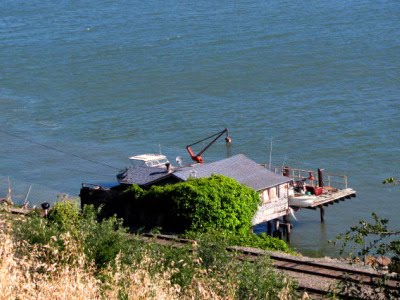
We finally partook of our nicest restaurant in honor of Julian's birthday and got some nice shots of the Carquinez Bridge. Water and grassland are our largest surrounding neighbors. We're learning to navigate our existence in between these two amazing ecozones.
On the hillside just opposite our front, we have watched cows and wild turkeys taking turns in the green green grass. They never seem to appear on the same morning.
And, new neighbors . . . getting to know slowly. Each seems a separate species; we are all coexisting in this little corner of the world called Crockett: the gang that spills out of the church hall after AA meetings, the sincere activists fighting the refinery's disregard for the local residents, the older people who gather for a free lunch at the neighborhood community center, the poets who come into town for a once-monthly reading series, and the bicyclers and motorcyclists who roll through on a Sunday, getting a taste of the "country."
We finally partook of our nicest restaurant in honor of Julian's birthday and got some nice shots of the Carquinez Bridge. Water and grassland are our largest surrounding neighbors. We're learning to navigate our existence in between these two amazing ecozones.
Tuesday, March 30, 2010
What the Children Saw
We peeked, each of us with one bare toe
Squeezed into a knothole,
Glad to trade the pain for another look.
We couldn't see any trees back there,
Just a concrete patio blotched with dirt, and
Blood, and in the far corner
Heavy wooden crates, bound with baling wire.
Full of rabbits, hundreds of them,
All young ones, hiding in the shadows.
Over their heads a sheet of crinkled metal
Stretched across the neighbor's yard.
Underneath, lined up against
The back fence were ten silver buckets.
Catching the steady drips from where
They hung, above, with their necks wrung out.
We peeked, each of us with one bare toe
Squeezed into a knothole,
Glad to trade the pain for another look.
We couldn't see any trees back there,
Just a concrete patio blotched with dirt, and
Blood, and in the far corner
Heavy wooden crates, bound with baling wire.
Full of rabbits, hundreds of them,
All young ones, hiding in the shadows.
Over their heads a sheet of crinkled metal
Stretched across the neighbor's yard.
Underneath, lined up against
The back fence were ten silver buckets.
Catching the steady drips from where
They hung, above, with their necks wrung out.
by Jannie M. Dresser, copyright/all rights reserved 2010
Thursday, March 25, 2010
Turkey Lurking
Wild turkeys couldn't drag me away . . . from the window this morning because they were the very point of my excitement. Looking out across to the green hill opposite of our home, there were nine of them, one male and his harem. The neighbor lady next door, who is mostly reclused with emphysema (we can hear her cough throughout the day and night) used to feed them and when I first moved to town, we watched a bunch of the birds strut down the middle of our street.
I grew up across from a chicken farm that became a turkey farm in Fresno. That was when there were still farmers in Fresno. (Well, there still are, but that gorgeous agricultural land is fast being paved over, as in "they paved paradise and put up a parking lot.") We kids played in the poultry runs after the birds all disappeared in the late autumn.
If everything we connect with in our lives is here to teach us something, I suppose turkeys have taught me not to trust stereotypes. To be a "turkey" is to be foolish, awkward, dim-witted, a loser. But these are magnificent birds and it is good to see the wild ones. Ben Franklin wanted the turkey to be our national bird, and I have to say, if the turkey had beat out the eagle, perhaps we would be a more accommodating society, learning to live with the earth rather than constantly soaring over it, trying to figure out what we could strike next.
I grew up across from a chicken farm that became a turkey farm in Fresno. That was when there were still farmers in Fresno. (Well, there still are, but that gorgeous agricultural land is fast being paved over, as in "they paved paradise and put up a parking lot.") We kids played in the poultry runs after the birds all disappeared in the late autumn.
If everything we connect with in our lives is here to teach us something, I suppose turkeys have taught me not to trust stereotypes. To be a "turkey" is to be foolish, awkward, dim-witted, a loser. But these are magnificent birds and it is good to see the wild ones. Ben Franklin wanted the turkey to be our national bird, and I have to say, if the turkey had beat out the eagle, perhaps we would be a more accommodating society, learning to live with the earth rather than constantly soaring over it, trying to figure out what we could strike next.
Monday, March 15, 2010
Country Diaries

In 1977, a delicately beautiful book came out, The Country Diary of an Edwardian Lady, which was a facsimile of Edith Holden of Warwickshire, England's 1906 diary. It chronicled her year of observing nature and showcased her illustrations of the local birds and plants she lived near.
Holden's "country diary" is my model, and Henry David Thoreau, John Muir, and other American naturalist philosophers are my inspiration for attending to the near of nature in my new environs along the Carquinez Straits. I begin with watching and drawing the birds.
Our backyard apple tree was left unpruned and still covered in slowly rotting fruit for the winter. This first attracted the Western Scrub Jays and Robins, but it is the Northern Mockingbird who really seized the tree as his territory, and for days we could watch him plumping himself on half-chewed apples.
In late February, I added a birdfeeder with sunflower and small seeds, and we have since been besieged by House Finch. But, this past week, I have also observed a large flock of Cedar Waxwings come through.
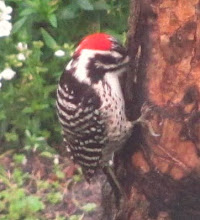
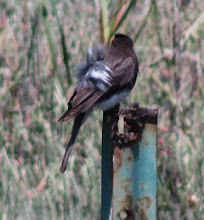
Other birds of note in the environs, have been Black Phoebes, a Northern Flicker, crows, mourning dove, vultures and a hawk I cannot identify as yet. We also were visited by a Yellow-Rumped Warpler and a Chestnut-Backed Chickadee.
"Women have less accurate measure of time than men. There is a clock in Adam: none in Eve," said Ralph Waldo Emerson. This doesn't have to be taken as a sexist remark (though sexism pervaded the culture in Emerson's day, he was relatively enlightened as to women's value and intelligence). Instead, I choose to read it as a compliment. To photograph a bird, for example, requires losing a sense of time; one must be patient and greatly slowed to wait for the right moment to snap the shutter. I am learning to photograph birds as I am learning to wait for the right moments when I shall snap the shutter.
Friday, March 12, 2010
Envy the Poor Immigrant
Crockett is a small town of about 3,000 people located at the northeastern tip of the San Francisco Bay. Here it is that the Carquinez Strait brings fresh water from California's High Sierra to the Pacific Ocean, via the San Pablo and San Francisco bays. I have old family history linking me to this place, of that more later.
I have lived in Oakland and Berkeley for over 30 years, loving it. Having immigrated first from Fresno, California, I came to the city for its cultural opportunities, the possibility of working in the field of my choice (bookselling and publishing), and for its cool guys. I met and dated a few of those, and finally, at the ripe age of 42, married one of the best. My husband is an actor in the SF Bay Area theater scene, an accomplished scholar of the drama, a hardcore Giants fan, and the sweetest smartest love I could have found.
I am a poet first of all, and have held all kinds of jobs. Currently, I am right in the cultural zeitgeist and not-so-fashionably unemployed. The move to Crockett fit in with having time and energy to make a new home and new friends.
This blog will explore country life at the edge of the SF Bay.
Labels:
California,
Crockett,
friends,
poets
Subscribe to:
Posts (Atom)